Green surfactants lead washing and care innovation
author: JDSCT
2025-01-09
| The consumer's concept of washing care has been taken by ordinary washing care Transition to health care As the consumers of Era z gradually become the main body People's awareness of environmental protection has gradually increased The consumer market is facing constant reshuffle and rapid upgrading How to highlight the encircling has become a big problem Let's get an early look at the topics of the BRF Green surface living and washing innovation |

  Surfactants are an indispensable additive. Adding a certain amount of surfactant solvent to the detergent can enhance the solubility and washability of the detergent, but because these solvents have a certain toxicity, it will have a significant irritating effect on the skin. The heavy use of surfactants can also be potentially harmful to ecosystems. In order to meet the increasing health care needs of people and ensure the sustainable development of human living environment, it is imperative to develop surfactants that are as non-toxic and harmless as possible to the human body and pollution-free to the ecological environment.
Green surfactants are processed from natural or renewable resources, green surfactants are divided into a variety of types, mainly including biological surfactants, degradable surfactants, reactive surfactants, synthetic surfactants, natural surfactants, that is, with natural, mild, small irritant and other excellent characteristics. Like traditional surfactants, green surfactants have hydrophilic and hydrophobic groups. Compared with traditional surfactants, green surfactants have high efficiency and strong deconfouling, excellent compatibility and good environmental compatibility, and show good emulsification, washing, solubilization, wettability, solubility and stability, which perfectly meets the needs of consumers in the z era.
At present, non-toxic and effective synthetic surfactants produced from renewable raw materials such as natural oils, starches, proteins, etc. are gradually becoming hot products in the industry, such as amino acid surfactants and alkyl sugars (APGs).
|
 Cocamide Methyl MEA CMMEA CAS 866889-75-0
 Cocamidopropyl Hydroxysultaine CAS 68139-30-0
|
1. Structural characteristics of amino acid surfactants
Amino acid surfactants are amphiphilic molecules formed by the combination of amino acids and their derivatives with fatty acids. They have a hydrophilic part (usually derived from natural amino acids or their derivatives, such as glycine, glutamic acid, etc.) and a liphilic part (usually long-chain fatty acids or their derivatives, such as cocoic acid, lauric acid, etc.). This structure enables it to significantly reduce surface tension at the water-oil interface, thus performing functions such as cleaning, emulsification, foaming, and solubilization.
 This structure enables it to significantly reduce surface tension at the water-oil interface, thus performing functions such as cleaning, emulsification, foaming, and solubilization. Amino acid surfactant can be summarized as the amino acid (such as glutamic acid, glycine, etc.) salts (sodium salt, potassium salt, triethanolamine salt) of coconut oil (or bay oil or palm oil) with foaming decontamination ability.
2. Properties of amino acid surfactants
Amino acid surfactants can be classified into basic, acidic and neutral types according to their acid-base, and further derived anionic, cationic, non-ionic and zwitterionic surfactants. Among them, N-acyl amino acid surfactant is the most common amino acid based surfactant formed by the condensation of fatty acyl group and α-amino acid, and is also the most widely studied and used one at present.
 Amino acid surfactants exhibit excellent surface activity, strong dispersion and emulsification of calcium soap, and also perform well under hard water conditions. The study showed that 0.5% mass fraction of sodium cocoyl methyl taurine in 150mg/kg of hard water and pure water foam height is almost the same, about 1.7cm. The equilibrium surface tension and critical micelle concentration (CMC) of amino acid surfactants decrease with the increase of carbon chain length.
 These surfactants have good biodegradability, indicating that they are friendly to the environment. Systematic studies have shown that N-acyl amino acid surfactants can efficiently degrade through the decomposition pathway of fatty acids and amino acids. For example, the biodegradability of sodium lauryl glutamate is superior to that of sodium branched alkyl benzene sulfonate and comparable to that of sodium dodecyl sulfate. Combined measurements showed that the biodegradation rate of amino acid-based surfactants was between 57% and 73% at 14 days.
 Amino acid-based surfactants have certain antibacterial effects due to the presence of unsaturated bonds or hydroxyl groups in the acyl chain, and this property is enhanced with the increase of unsaturation and number of hydroxyl groups. The results show that the antibacterial effect of arginine surfactant on gram-positive bacteria is more significant than that on Gram-negative bacteria. The antibacterial properties of N-acyl amino acid surfactants against Escherichia coli, Staphylococcus aureus and Pseudomonas aeruginosa were studied in detail, and the effect of pH value on the antibacterial properties was discussed. The results showed that these surfactants had good inhibition effect on the above bacteria, but their antibacterial activity would be decreased in the environment with pH value greater than 6.
3. Application of amino acid surfactants
In the washing products, the amino acid surfactant has less stimulation to the skin and eyes, and its degreasing ability is relatively low, which can maintain a good skin feeling after washing, help to keep the skin moisture, long-term use will not damage the skin and hair, and also has a certain nursing effect.
 |
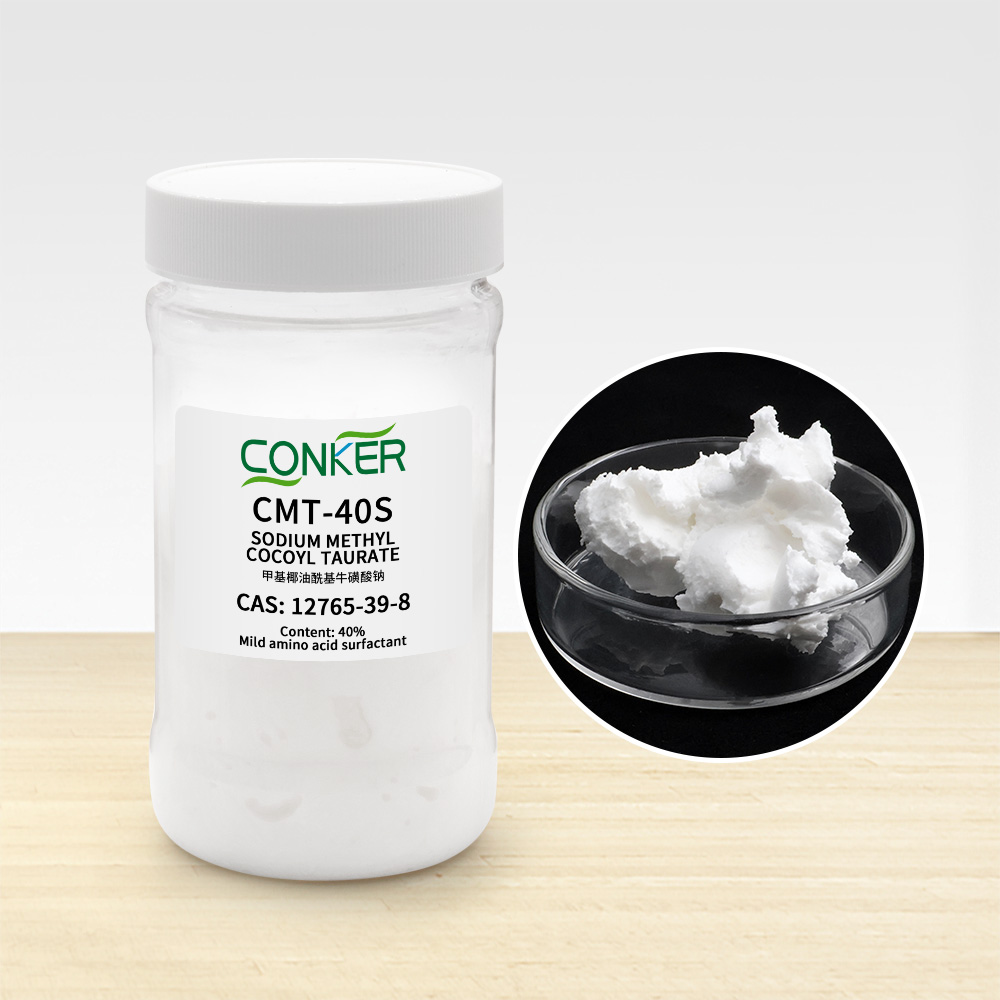 Sodium Methyl Cocoyl Taurate CAS 12765-39-8
Analysis of Southeast Asia Market Trends and High-Potential Categories for 2025
Strongest whitening agent